
Marks of the Trade
Thoughts on being in dialogue with the landscape, contractors as designers, and the roles of maker, material and memory through the lens of our Woodstock project.
Special thanks to Ricardo Castro, Gabino Chavez, and the rest of the SRL crew for all they do. To protect the identities of workers, no images of faces are featured.
As a young practice, we’ve learned that the inflection point of the design process that makes for success isn’t the provision of a showy concept, but relies more on the slow burn of deep observation and listening. Egos are checked at the gate in order for landscape architects to fully understand the limitations and capabilities of a project site in conjunction with the needs of their users. This holds true for every stage of the process, from inception through to completion, perhaps more so within the construction phase. Why choose to walk away from the dish while it’s on the stove?
For ALA, the act of ‘listening’ is inclusive of attunement to site and installer throughout the duration of the construction process. Initial understanding of a site through analysis is foundational, but the ability to listen to a site as it is unmade and remade and those who shepherd the process determines the degree to which an installation thrives. To put it simply: the clarity of our project goals and their successes depend on our ability to communicate well with those who make the landscape.
Our Woodstock Overlook project made in collaboration with contractor Stone Ridge Luxury Landscapes is a relevant case study. The stage is a secondary residence set within beautiful oak hickory and hemlock woodland, surrounded by outcroppings of stratified sandstone, siltstone, and loose piles of shale that were reminiscent of a Jon Piasecki installation. Parts of our design brief were relatively easy to understand; for example, bring the backyard patio and pool into the 21st century and make it more user-friendly. One bigger, unspoken missive was more of a sticking point: how do we not ruin the space we’ve been given to play in?
Working with this stone—honoring the materiality, where it came from, whose hands it had passed through before it got to us—was one of the most exciting components of this project for me. Big moves included shifting geometries to make the most of views of the Catskills with plantings that soften the scale of the view and delineate more generous gathering and recreational spaces. Finding the correct curation of plantings to exist in dialogue with the stone, which acted as a sort of gravitational center for the work, was a really gratifying and fun challenge.
Initial selection of boulders by SRL and ALA at the outskirts of the property for the rough, blocky stone intended as a seating stone for the overlook and to flank the steps to the pool revealed an exciting discovery: a large deposit of loosely consolidated shale, which Ricardo noted was likely an indication of the site’s previous use as a quarry. SRL’s team later uncovered stones with quarry marks from iron pins used for splitting the stone from bedrock, confirming our suspicions of the site’s prior use.
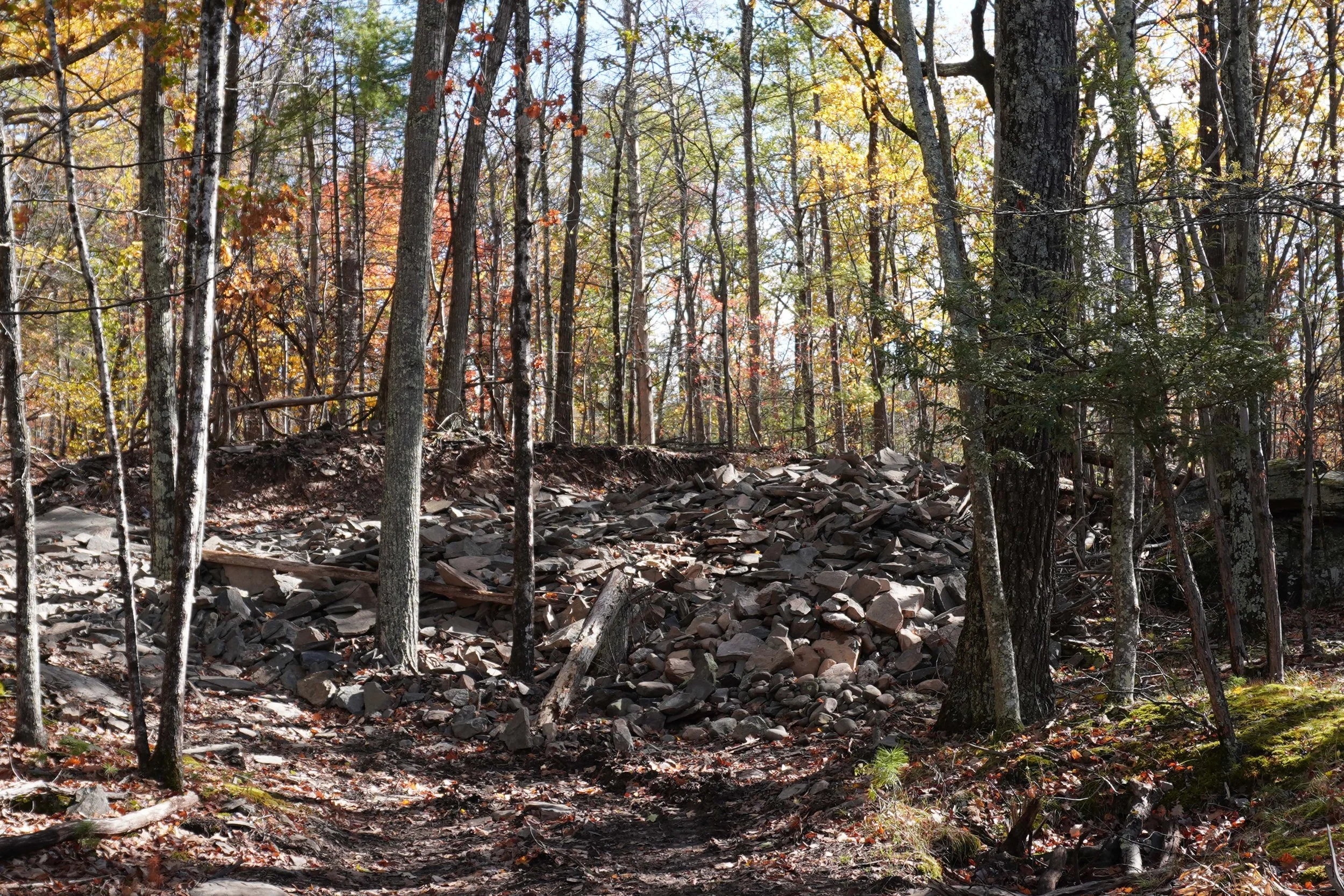
Selecting boulders from the site’s fringe revealed a wealth of unconsolidated stone, which would have been considered ‘waste’ quarry material.
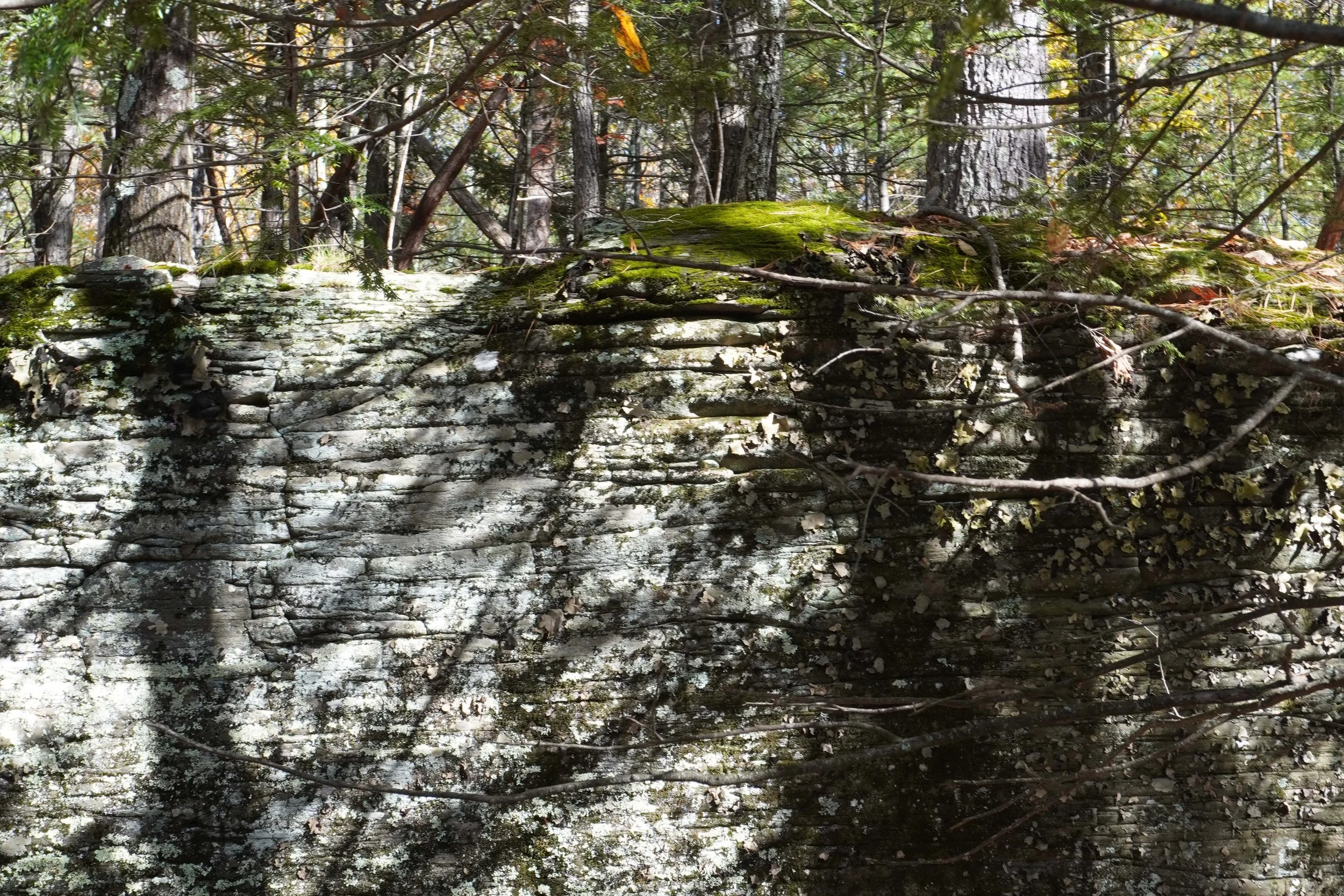
Inspiration for the stone wall finishes abounds in the natural buildup of sedimentary rock at the site.
Stone has several permutations within the project: as highly finished retaining walls and seat walls, looser aggregations of stone for retainment of soil in less visible areas, punctuation in the rock garden that surrounds the house, seating boulders, and boulder-style retaining features.
The quarry pieces identified following boulder selection were uniquely suited for the more highly-finished retaining walls. Preliminary specification for these features showed a thinner, more irregular stone that would have likely required offsite sourcing. In contrast, the relatively uniform, 4”-6” shale pieces likely designated as ‘waste stone’ by the quarry made for a blockier, more polished stone wall that had more gravity in its construction.
Gabino and his team made multiple back and forth to the site ‘quarry’ to procure each bucketful of stone for the retaining walls.
Despite the relative flatness of each stone (a product of a millennium of sedimentation), all pieces were hand-finished by Gabino and his team to eliminate harsh angles from their faces and fit into the puzzle of rectilinear blocks. The process was slow and took longer than most stone walls take to build, but the product speaks for itself.
Rather than chiseling and hacking pieces into submission, ‘good’ faces of the stone were parsed relative to the whole of the piece and were selected for readily visible parts of the wall. Each stone was finished by hand chiseling and subsequently found placement as part of a larger whole within the wall. Gabino and his team then concreted in each piece, finishing out the top of the wall with polymeric sand jointing atop the mortar for a look with a lighter hand.
From afar, the wall feels effortless. It would be easy to assume that a delivery of largely rectangular blocks was made to the site and simply assembled to make the structure what it is. Up close, the material tells a different story. Chisel marks are apparent on many of the stone faces, looking like larger scratch marks, telling the tale of not only the work done by the project team, but also the site’s history and origins as a quarry . These will eventually weather out in time, and there is no intention or desire to soften the appearance of these marks in the intervening months, as in doing so, the act of labor and care made explicit within and imposed upon the landscape would be erased from the site. Interestingly, the same can be said of the plantings, which were chosen to seamlessly integrate with the surrounding environment, though reflect a deep consideration and specific vision.
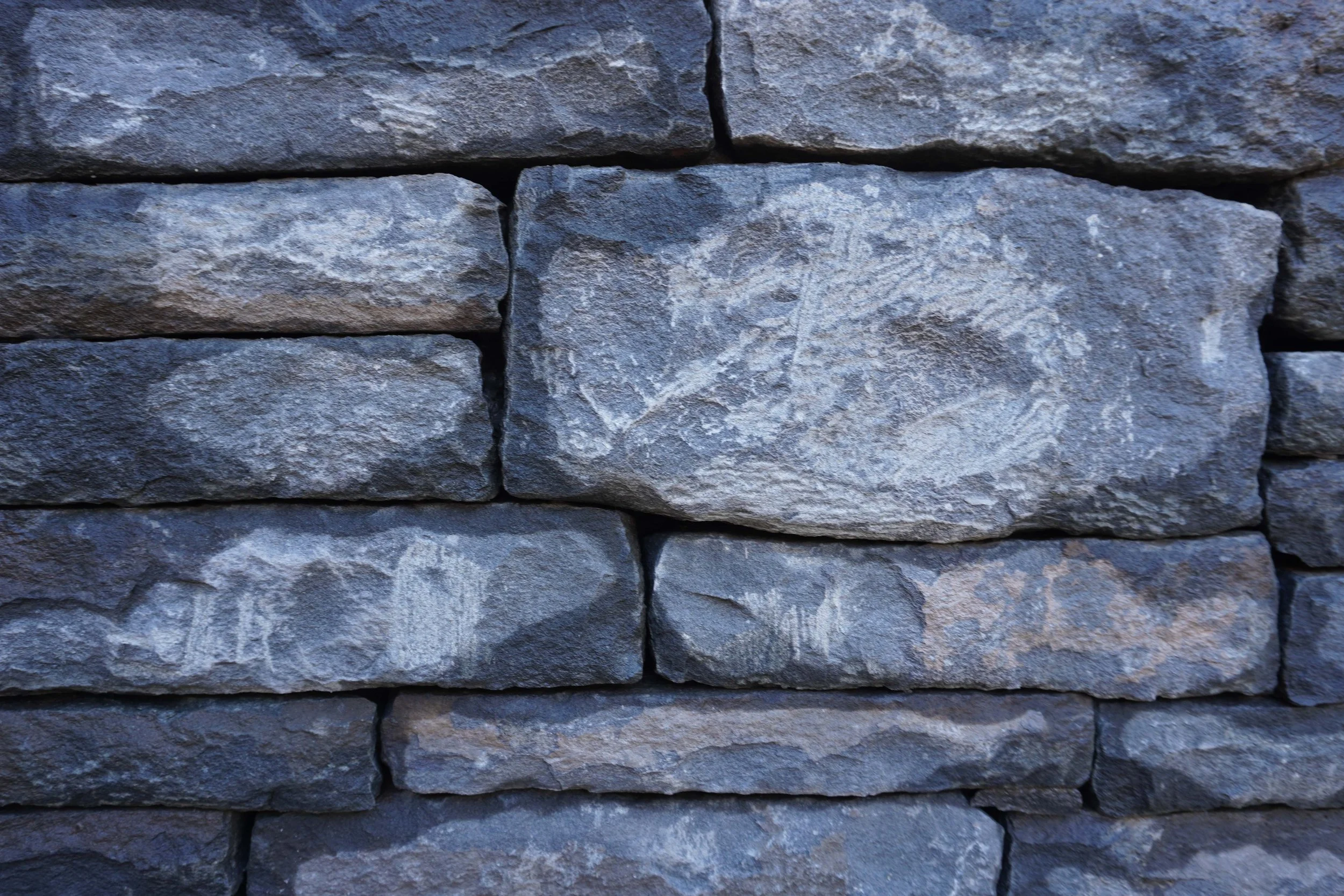
Scratches from a rock hammer are visible in the wall finish.
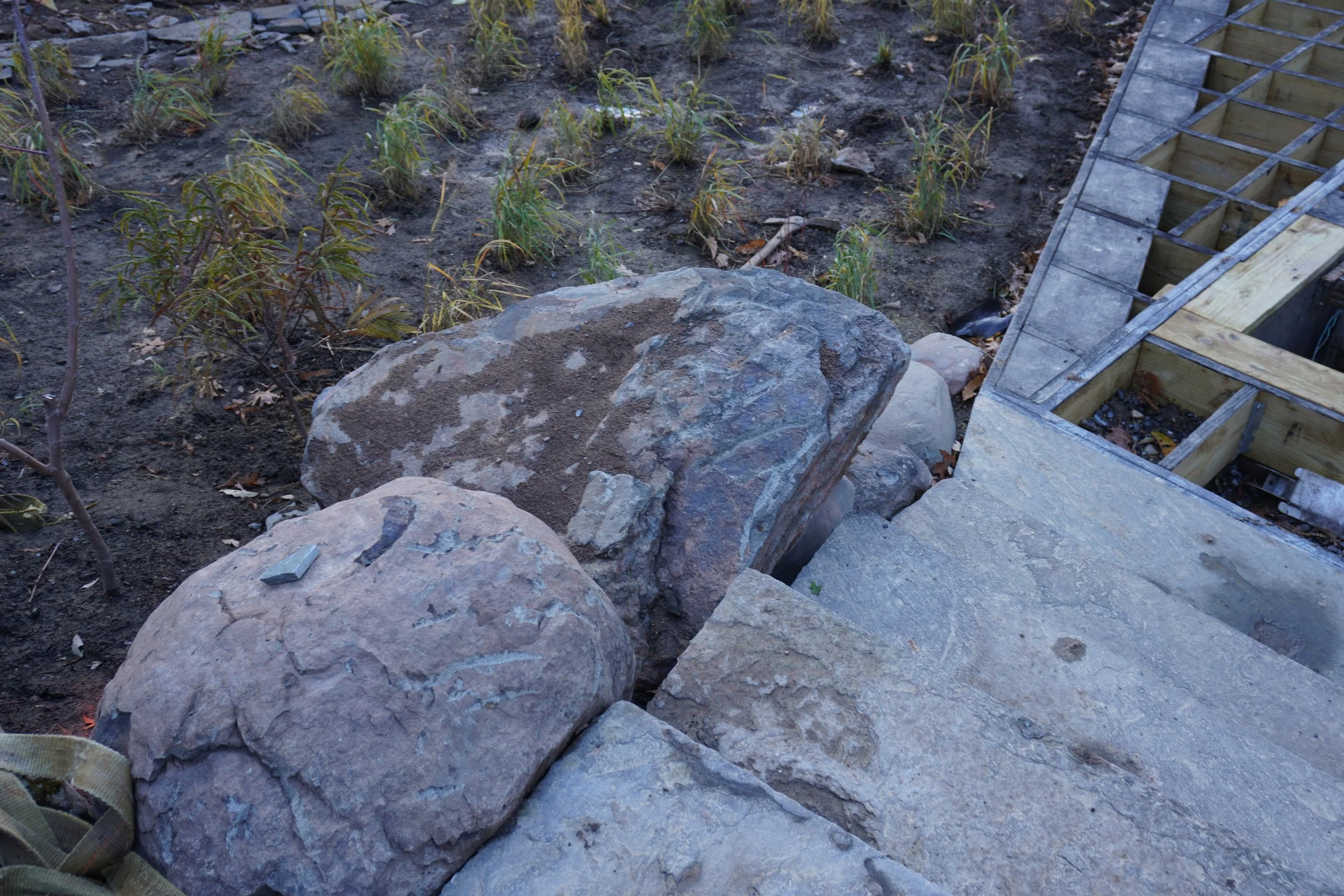
Boulders unearthed from the site perimeter and the excavation of the pool find their way as punctuation of paths and patios.
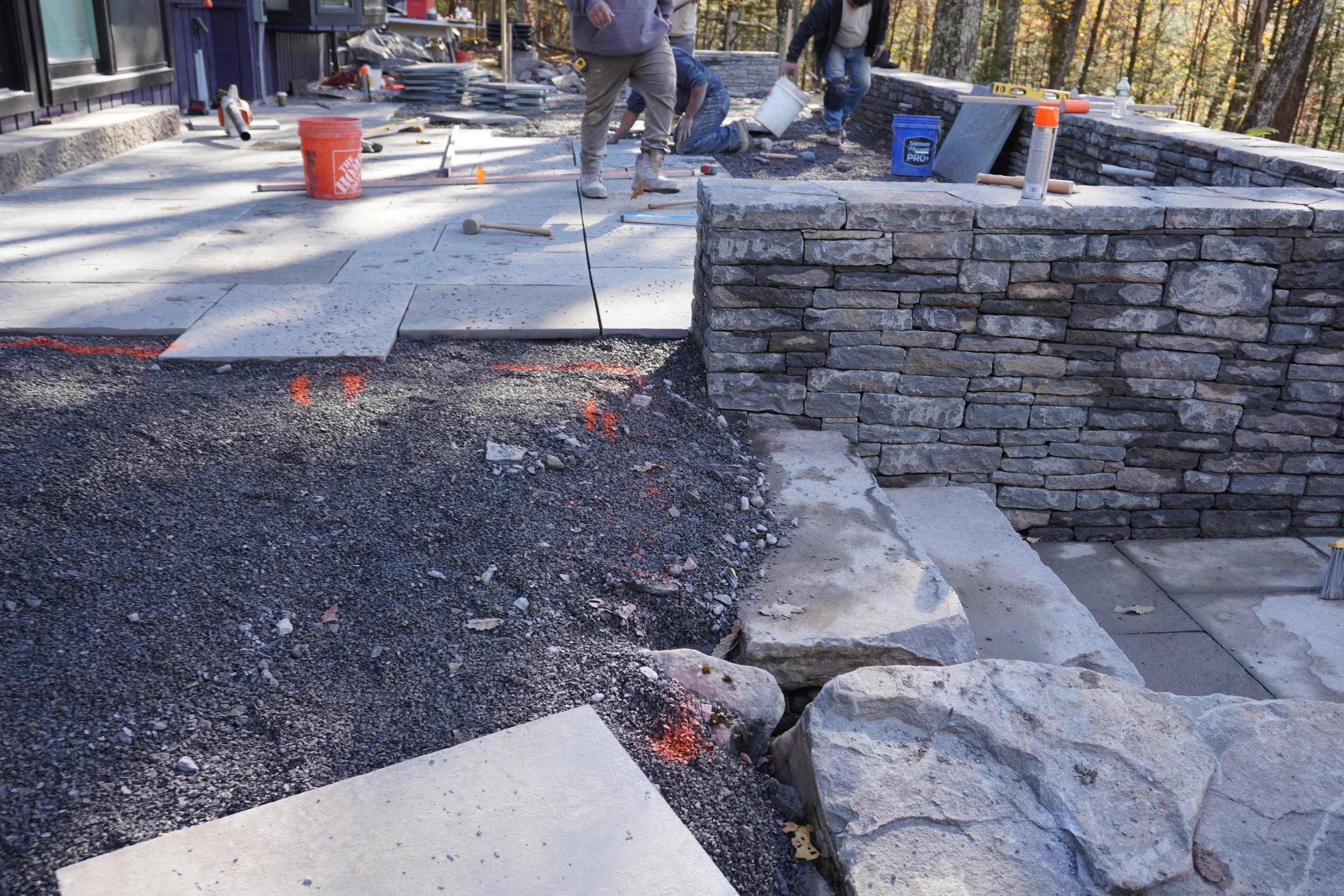
Textured bluestone surface of the flatwork complements the intricate wallstone.
I am struck by how much of the process was reliant on two things: the ability to clearly communicate design intent, and the necessity to be able to take a step back and trust the skill of the installers. When drawings weren’t enough, we felt we were in good hands with SRL’s team, who were willing to experiment alongside us to finish out the project in a way that showed deep respect for the site and its inhabitants. Contractors have design agency throughout the process, if not more so when it comes to the execution of a design, and we are thankful for the collaborative nature of these relationships and the projects made better by them. As a practice, ALA celebrates the role of the landscape installer as design collaborator and seeks to highlight the painstaking, hard, and highly skilled work that makes our projects come alive.
